




















🏛 Contractor Knowledge Academy
Lesson #2:
✅ How to Get Your Certificate of Insurance Accepted the First Time
Estimated Reading Time: 8minutes • Last Updated: July 2026
🏛 Contractor Knowledge Academy
Lesson 1: Why General Contractors Require a Certificate of Insurance
Estimated Reading Time:
6 minutes • Last Updated: July 2026
🏛 Contractor Knowledge Academy
Lesson #2: Why Certificates of Insurance Get Rejected
(And How to Avoid It)
Estimated Reading Time: 8minutes • Last Updated: July 2026
🏛 Contractor Knowledge Academy
Lesson 1: Why General Contractors Require a Certificate of Insurance
Estimated Reading Time:
6 minutes • Last Updated: July 2026
COI-102
COI
✅ How to Get Your Certificate of Insurance Accepted the First Time
Why General Contractors Require a Certificate of Insurance Before Work Begins
COI-102
COI
Why Certificates of Insurance Get Rejected (And How to Avoid It)
Why Certificates of Insurance Get Rejected (And How to Avoid It)
Welcome to the 🏛 Contractor Knowledge Academy
Whether you're a new contractor or you've been in business for decades, understanding insurance requirements
can help you avoid costly mistakes, keep projects moving, and win more work.
Each lesson is designed to answer common contractor questions using real-world examples and practical guidance—not insurance jargon.
The Certificate of Insurance Checklist Every Contractor Should Know
COI-102
The Certificate of Insurance Checklist Every Contractor Should Know
Contractor Knowledge Academy – Lesson #2
The Certificate of Insurance Checklist Every Contractor Should Know
Before you send your next Certificate of Insurance...
Take one minute to verify these seven items.
A simple checklist can help keep your project moving, reduce revision requests, and make sure your certificate meets your customer's contract requirements.
Most Certificate of Insurance delays aren't caused because a contractor lacks insurance—they're caused by missing information, incorrect certificate holder details, or required endorsements that weren't requested.
This guide walks you through the 7 most important items to verify before submitting your Certificate of Insurance, helping you avoid unnecessary delays and keep your projects on schedule.
👉 Want to understand every section?
Read our Complete Certificate of Insurance Guide. (Internal Link)
I actually like this even better because it creates curiosity without sounding negative.
Or even this version:
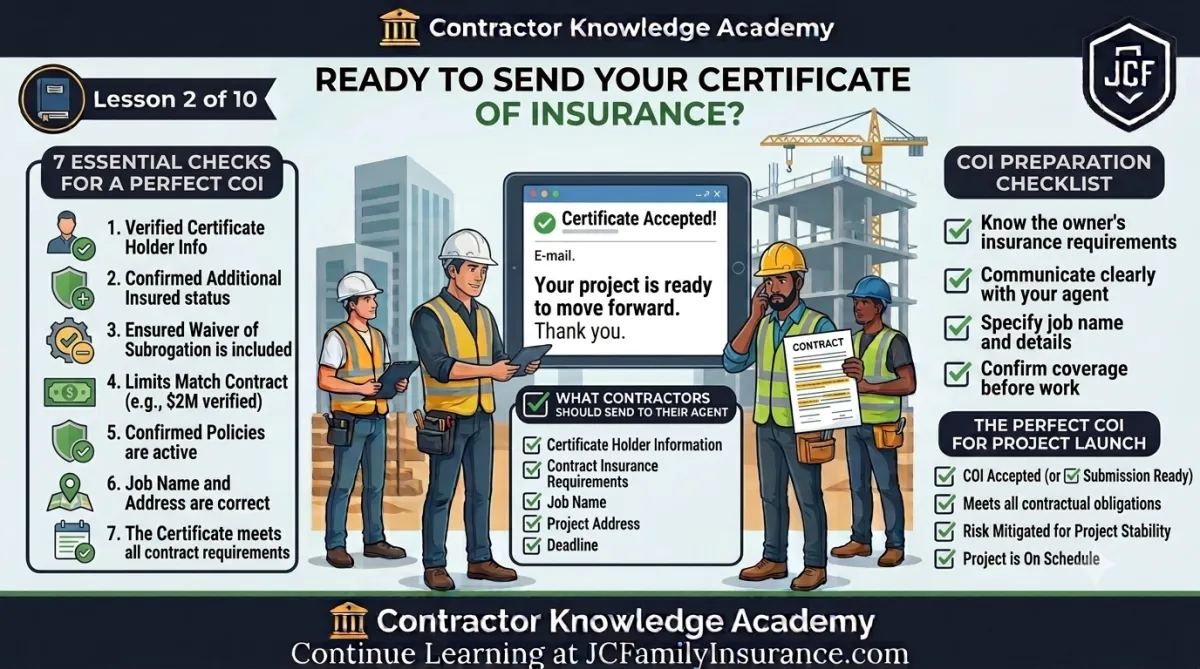
Ready to Send Your Certificate of Insurance?
Before you hit "Send," take 60 seconds to verify these seven items.
A quick review can help ensure your certificate meets contract requirements, avoid unnecessary revisions, and keep your project moving forward.
Inside this lesson you'll learn:
✔ What information your insurance agent needs
✔ Which endorsements are commonly required
✔ How to compare your certificate against contract requirements
✔ The seven items every contractor should verify before submitting a Certificate of Insurance
For many contractors, it's just another piece of paperwork. In reality, it's one of the most important documents on a construction project.
A Certificate of Insurance (COI) helps general contractors verify that subcontractors meet the insurance requirements outlined in the contract. Without an approved certificate, work may be delayed, payments can be held up, or you may not be allowed on the jobsite.
Understanding why contractors request Certificates of Insurance—and what they're actually reviewing—can help you avoid unnecessary delays and keep your projects moving.
What Is a Certificate
of Insurance?
Lesson 2 of 10
- Next Lesson
👉 What is Additional Insured?
Coming Up in Lesson 3
Many Certificates of Insurance are rejected because a contract requires an Additional Insured endorsement. In the next lesson, you'll learn what it is, why it's required, and how it affects contractors working on commercial projects.
👉Contractor Knowledge Academy- Lesson 3 of 10- (Link- Continue to Lesson-3)
While it provides evidence that insurance exists, a COI is not the insurance policy itself. It does not change, expand, or replace the terms of your policy.
Lesson 2 of 10
- Next Lesson
👉 What is Additional Insured?
Coming Up in Lesson 3
Many Certificates of Insurance are rejected because a contract requires an Additional Insured endorsement. In the next lesson, you'll learn what it is, why it's required, and how it affects contractors working on commercial projects.
👉Contractor Knowledge Academy- Lesson 3 of 10- (Link- Continue to Lesson-3)
While it provides evidence that insurance exists, a COI is not the insurance policy itself. It does not change, expand, or replace the terms of your policy.
What Is a Certificate
of Insurance?
What Is a Certificate of Insurance?
A Certificate of Insurance (COI) is a document that summarizes your insurance coverage at the time it is issued. Most Certificates of Insurance are created using the industry-standard ACORD 25 form.
A Certificate of Insurance (COI) is a document that summarizes your insurance coverage at the time it is issued. Most Certificates of Insurance are created using the industry-standard ACORD 25 form.
Lesson 2
Certificate of Insurance Checklist Every Contractor Should Know
You receive your Certificate of Insurance.
Before you send it...
Take one minute to verify these seven items.That simple checklist can help keep your project moving.
Most Certificate of Insurance delays are caused by missing information rather than missing insurance. This checklist helps contractors verify their certificates before sending them to a general contractor or project owner.
Why Certificates Need to Meet Contract Requirements
General contractors, municipalities, developers, property managers, and large commercial customers review thousands of Certificates of Insurance every year.
They're not trying to make life difficult. They're simply verifying that your insurance meets the requirements outlined in the construction contract.
When something doesn't match, corrections are needed before the certificate can move forward.
The 7-Point Certificate of Insurance Checklist
What Contractors Should Send Their Insurance Agent
Instead of saying "I need a certificate," send:
- ✓ Certificate Holder Information
- ✓ Contract Insurance Requirements
- ✓ Job Name
- ✓ Project Address
- ✓ Deadline
The more information your insurance agency receives, the faster the certificate can usually be completed.
The Missing Endorsement That Delayed a Project
A framing contractor was scheduled to begin work Monday morning.
Friday afternoon, the GC flagged the certificate because the contract required Additional Insured, Waiver of Subrogation, and Primary & Non-Contributory wording.
Those endorsements had to be confirmed before a revised certificate could be issued. The project start was delayed while corrections were completed.
Can You Complete the Checklist?
This sample certificate is missing a few checklist items. Tap a field to see what's needed and how to fix it.
Tap a field above to see the problem.
Related Lessons
Need a Certificate Reviewed?
Before submitting your Certificate of Insurance to a general contractor or project owner, let our team review the requirements. We'll help verify that your certificate includes the requested information and explain any insurance requirements that may apply.
Frequently Asked Questions
A Typical COI Includes:
- Named Insured
- Insurance Company Information
- Policy Numbers
- Effective and Expiration Dates
- Coverage Types
- Policy Limits
- Certificate Holder
- Description of Operations
👉 Want to understand every section? Read our Complete Certificate of Insurance Guide. (Internal Link)
While it provides evidence that insurance exists, a COI is not the insurance policy itself. It does not change, expand, or replace the terms of your policy.List item 1
Lesson 2 of 10
- Next Lesson
👉 What is Additional Insured?
Coming Up in Lesson 3
Many Certificates of Insurance are rejected because a contract requires an Additional Insured endorsement. In the next lesson, you'll learn what it is, why it's required, and how it affects contractors working on commercial projects.
👉Contractor Knowledge Academy- Lesson 3 of 10- (Link- Continue to Lesson-3)
While it provides evidence that insurance exists, a COI is not the insurance policy itself. It does not change, expand, or replace the terms of your policy.
Lesson 2 of 10
- Next Lesson
👉 What is Additional Insured?
Coming Up in Lesson 3
Many Certificates of Insurance are rejected because a contract requires an Additional Insured endorsement. In the next lesson, you'll learn what it is, why it's required, and how it affects contractors working on commercial projects.
👉Contractor Knowledge Academy- Lesson 3 of 10- (Link- Continue to Lesson-3)
While it provides evidence that insurance exists, a COI is not the insurance policy itself. It does not change, expand, or replace the terms of your policy.
Lesson 2 of 10
- Next Lesson
👉 What is Additional Insured?
Coming Up in Lesson 3
Many Certificates of Insurance are rejected because a contract requires an Additional Insured endorsement. In the next lesson, you'll learn what it is, why it's required, and how it affects contractors working on commercial projects.
👉Contractor Knowledge Academy- Lesson 3 of 10- (Link- Continue to Lesson-3)
While it provides evidence that insurance exists, a COI is not the insurance policy itself. It does not change, expand, or replace the terms of your policy.
Coming Next...
🚧 Contractor Nightmare
"The Contractor Who Lost a $2 Million Project Because of One Missing Endorsement."
Sometimes the difference between winning a job and losing one isn't your price—it's your paperwork.
🏛 Contractor Knowledge Academy
JC Family Insurance
Need a Certificate of Insurance?
Whether you need a standard Certificate of Insurance or one that includes Additional Insured, Waiver of Subrogation, Primary & Non-Contributory wording, or project-specific requirements, JC Family Insurance can help.
🏛 Contractor Knowledge Academy | JC Family Insurance
Need a Certificate of Insurance?
Whether you need a standard Certificate of Insurance or one that includes Additional Insured, Waiver of Subrogation, Primary & Non-Contributory wording, or project-specific requirements, JC Family Insurance can help.
Common questions answered
Answers to Frequently Asked Questions
Why was my Certificate of Insurance rejected?
Most certificates are rejected because required information or endorsements are missing—not because the contractor has no insurance.
Does a certificate prove I meet every contract requirement?
Not necessarily. The certificate summarizes coverage, but it does not replace your policy or guarantee that every contractual insurance requirement has been met.
Can I start work if my certificate is rejected?
Many general contractors require an approved Certificate of Insurance before allowing subcontractors to begin work on the project.
What is Waiver of Subrogation?
A Waiver of Subrogation endorsement may prevent your insurer from seeking recovery from another party after paying a covered claim, when required by contract. Learn more in Lesson #4.
How long does it take to issue a Certificate of Insurance?
Simple certificates can often be issued quickly, but requests involving endorsements or contract review may take longer depending on the circumstances.
Can an insurance agent change a certificate?
An agent can accurately reflect the coverage that exists on your policy, but a certificate cannot create or alter coverage. If a contract requires an endorsement, the policy must include it.
What is the most common reason certificates are rejected?
Missing endorsements, incorrect certificate holder information, and coverage limits that don't match the contract are among the most common reasons.
What is an Additional Insured endorsement?
It extends certain protections under your policy to another party when required by contract. Learn more in Lesson #3.
What does Primary & Non-Contributory mean?
It generally addresses how your insurance responds in relation to another party's insurance when required by contract. It must be supported by the policy where applicable.
Where can I learn more about contractor insurance requirements?
Explore the rest of the Contractor Knowledge Academy, your Interactive COI guide, and our contractor licensing resources for Washington, Oregon, and Idaho.
Want to work with us?
Get contractor insurance, bonds, and certificates from a local team that understands how your business works.